
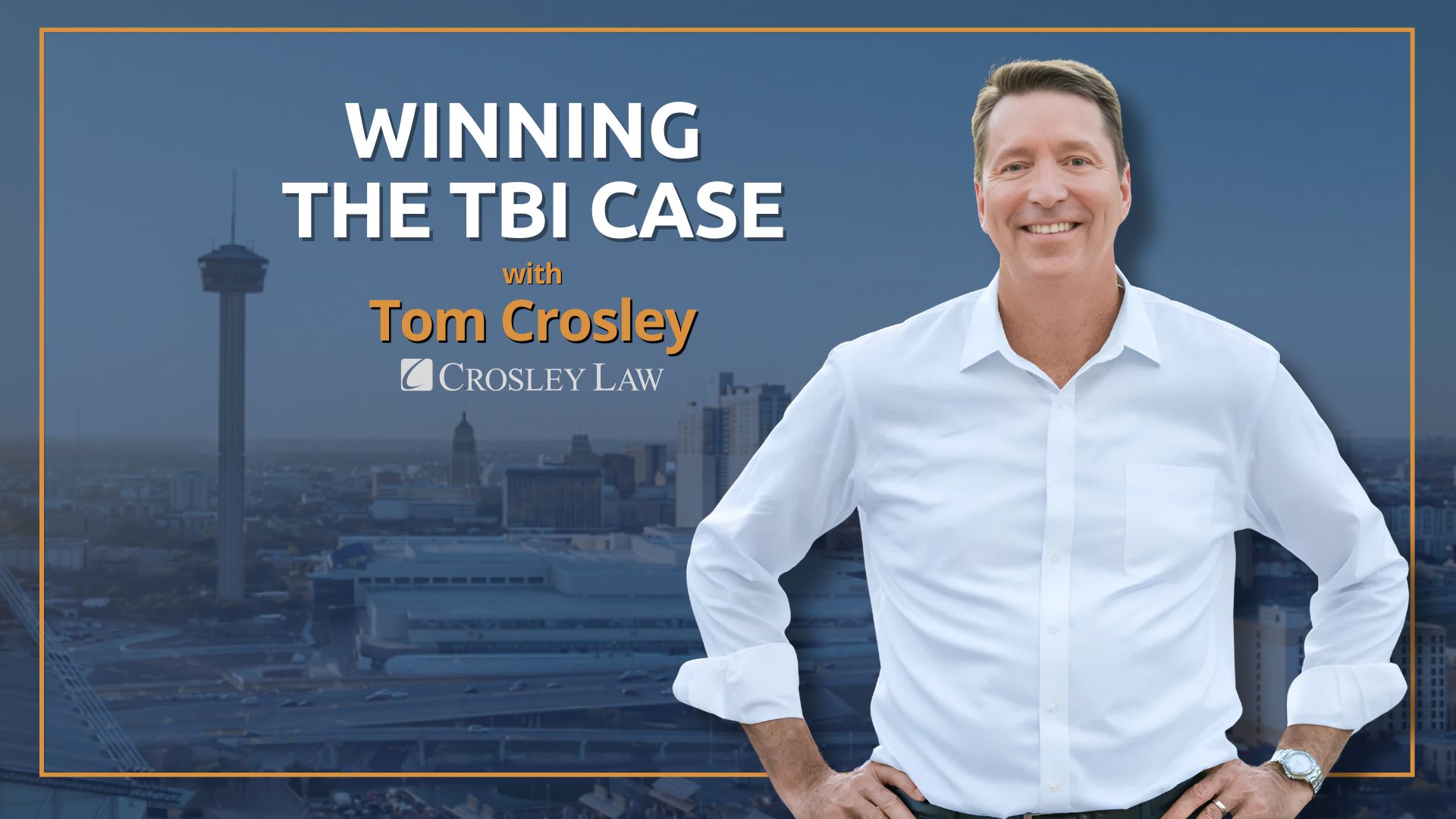



Introduction of Winning The TBI Case: Strategy, Science, and Storytelling
Imagine standing in a courtroom, representing someone whose life has been forever changed by an injury no one can see. No broken bones visible on X-rays. No scars to photograph. Just a person who looks perfectly normal on the outside, but whose brain and the very essence of who they are, has been fundamentally altered.
This is the world Tom Crosley introduced us to twelve episodes ago. “Traumatic Brain Injury trials are some of the most complex and contentious litigation scenarios that you can encounter as a trial lawyer,” he explained, setting the stage for a journey through one of law’s most challenging frontiers.
TBI Trial Strategy Fundamentals & Advanced TBI Case Strategies with Keith Mitnik
Keith Mitnik joined the conversation early to share a profound truth that shapes everything in TBI litigation: You need two completely different skill sets to succeed.
“People either step in and try them and don’t truly know the science,” Keith observed, “or they know the science in their sleep, but they don’t know how to try a case with it. It takes both to do them right.”
This isn’t your typical car crash case involving a herniated disc. This is a whole different universe of knowledge. And here’s where it gets interesting—Keith revealed that when medical bills are minimal compared to the damages you’re seeking, sometimes the boldest move is not presenting them at all.
“Insider information gets in our way,” he explained. “We know we like to present medical bills. We know not presenting them may be unusual. Guess who doesn’t: the jury.”
Sequencing the Evidence
Tom then pulled back the curtain on one of the biggest mistakes lawyers make in TBI cases: telling the story in the wrong order.
“Have you ever watched a movie where the twist at the end completely changed how you saw everything that came before it?” Tom asked. “Trying a TBI case is a lot like that.”
The strategy is surgical in its precision: Build a wall of evidence before the jury ever meets your client. Prove the injury is real before the defense gets a chance to argue it isn’t. Win half the battle in your first two or three witnesses, drilling the point home so sharp and so early that momentum carries you through.
How Expert Witnesses Build a Wall of Evidence
But evidence alone doesn’t win cases. connection does. Tom revealed that while experts might be the brain of your case, before-and-after witnesses are its heart and soul. These are the people who knew your client before the injury, who can paint the picture of what was lost. They translate MRI scans and medical terminology into something jurors can see, feel, and understand.
“When done right,” Tom emphasized, “they push jurors from understanding to truly caring. And that’s what wins cases.”
The Power of Before-and-After Witnesses and Introducing the Plaintiff for Maximum Impact
Here’s where the strategy gets almost paradoxical: In most TBI cases, Tom doesn’t let the jury see his client until deep into the trial, perhaps the 17th witness out of 20.
“Timing is everything,” he explained. “You do not put the plaintiff on the stand until the jury is primed to see their injury and not just in medical terms, but in human terms.”
By the time the plaintiff finally appears, the jury has been educated, emotionally invested, and prepared to truly see the invisible injury that has upended this person’s life.
How to Tear Apart the Defense’s “Junk Science” Experts
Episode eight brought us into the trenches of cross-examination, where Tom laid out his systematic approach to destroying defense experts in what he calls “junk science witnesses.”
The strategy starts in discovery, trapping them early. Then comes the methodical dismantling:
- Expose their bias as paid witnesses
- Use their own words against them
- Transform their “normal limits” argument into a weakness
- Remind the jury that biomechanical engineers aren’t doctors
- Follow the money trail to expose the hired gun relationship
“Nothing kills credibility faster than a hired gun in the hip pocket of the defense lawyer,” Tom noted with satisfaction.
TBI: Not Everyone Recovers
Then came the bombshell research every TBI lawyer needs to know. Tom shared groundbreaking data that destroys the myth that everyone recovers from brain injuries:
“Only 27% of patients with post-concussive syndrome recovered after three months.”
Let that sink in. And it gets more powerful: If symptoms persist beyond a year, patients are more likely than not permanently injured. And if symptoms last three years? The study found zero recovery after that point.
This isn’t opinion. This is science. This is ammunition.
The Multiplying Effect of Injuries with Steven Gursten
Steven Gursten brought another crucial insight in episode ten, explaining how multiple injuries don’t just add up—they multiply human suffering.
“Two plus two does not equal four in the human body,” his favorite doctor testified. When you have multiple injuries, people’s problems go up by multiplication, not addition. This reflects where we are today with medical literature and science—understanding the cumulative, synergistic effect of trauma on the human body.
The All-or-Nothing Nature of TBI Cases with Steven Gursten
Steven also pulled no punches about the harsh reality of TBI litigation: These cases are incredibly difficult to settle.
“80 to 90% of plaintiff lawyers out there are afraid to take these cases,” he revealed. “They settle them for basically nuisance dollars because they’re afraid they’ll going to get no-caused.”
The message is clear: You must have a track record of trying these cases for insurers to take you seriously. If you don’t, you’re just another lawyer they can lowball into submission.
Mastering TBI Science with Stewart Casper
Our journey culminated with Stewart Casper, who has spent over two decades building what might be the most comprehensive TBI research database in the legal world. Labeled a “nerd” for his dedication, Stewart has systematized knowledge gathering into an art form.
Every weekend, he receives automated searches from PubMed for traumatic brain injury, mild traumatic brain injury, diffusion tensor imaging, and symptom validity. He categorizes everything into two buckets: What can be used for impeachment, and what’s educational.
“Not many people have the patience to both study this stuff and index it as I do,” Stewart admitted. But that patience—that systematic approach to staying current—is what separates the warriors from the wannabes in TBI litigation.
The Path Forward
After twelve episodes, the message is crystal clear: TBI litigation isn’t for the faint of heart. It demands a rare combination of scientific mastery and storytelling brilliance. It requires the courage to leave medical bills on the table when they don’t serve your narrative. The wisdom to keep your client hidden until the perfect moment. The preparation to systematically destroy defense experts. And the commitment to stay current with ever-evolving science.
But for those willing to master both sides of this coin—the science and the story—the opportunity is immense. Because behind every “invisible” injury is a very real person whose life has been forever changed. And they deserve a lawyer who knows how to make the invisible visible, who can transform medical data into human truth, and who won’t settle for nuisance value when justice demands so much more.
This is the world of TBI litigation. This is what winning looks like.
Connect With Us
Have a topic idea or question for Tom? Email us at [email protected]
If today’s recap reminded you why this work matters, share it with a colleague facing similar battles. Subscribe wherever you get your podcasts and join our community of trial lawyers who refuse to settle for average results.
This has been “Winning the TBI Case: Strategy, Science and Storytelling” with Tom Crosley