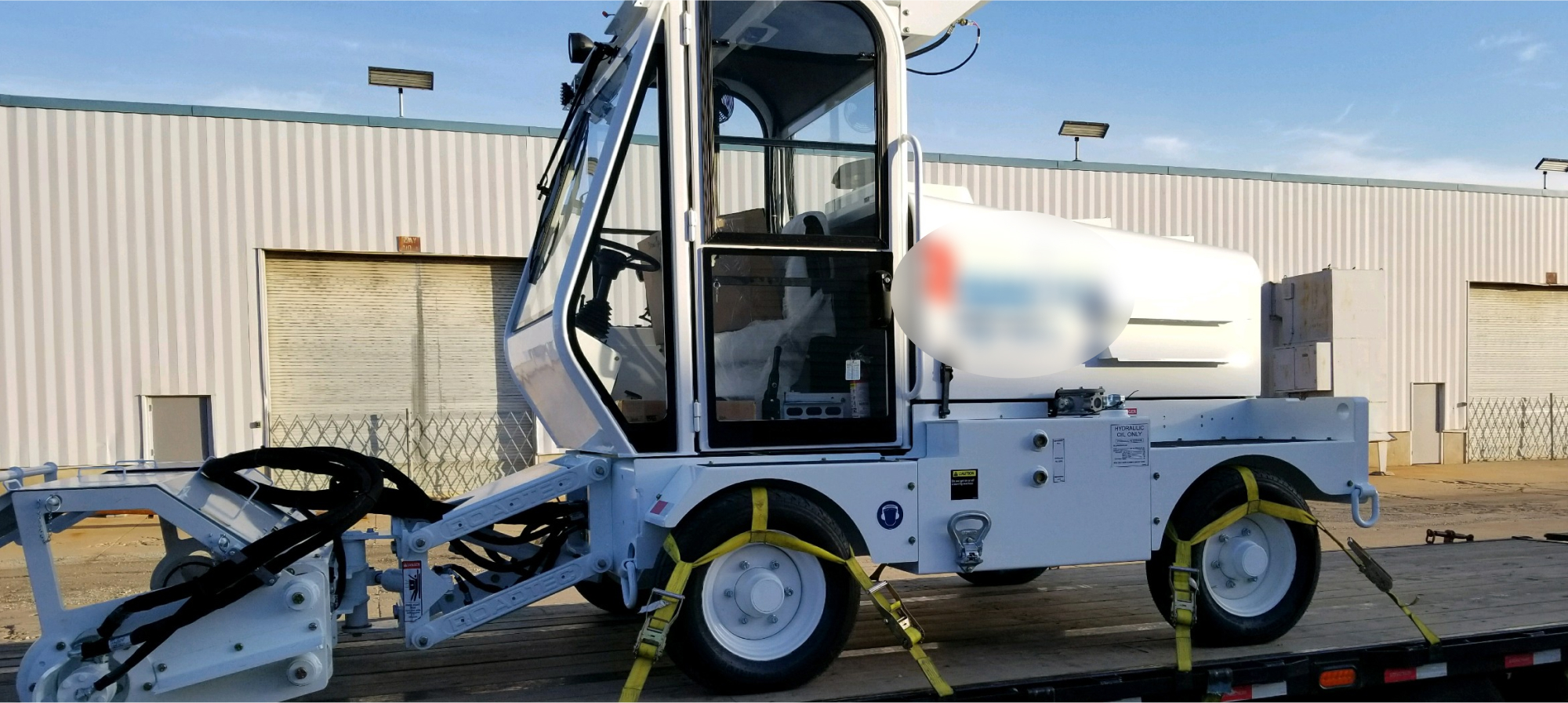



Crosley Law recently obtained a settlement in an extremely complex and tragic wrongful death case that took place in rural Oklahoma.
This case required more than six years of hard work, detailed focus group research, and honing of legal arguments. But in the end, our wrongful death lawyers were able to get our client and her family the accountability, closure, and meaningful compensation they deserved.
A simple job ends in tragedy
Francisco* and his wife Nina* were co-owners of a long-haul heavy machinery transport company. They drove a commercial pickup pulling a 40-foot trailer.
On the morning of the incident, Francisco and Nina had been hired by an equipment manufacturer to pick up and transport a pair of street sweepers, commonly known as “brooms.” It was a cold and overcast day with light mist.
Safely loading a street sweeper onto a trailer is not difficult, but it does require a trained driver who is cautious and carefully follows safety protocols.
Here’s how it was supposed to work. Francisco would stand on the trailer just long enough to ensure that the tires of the street sweeper were properly lined up with the ramp. Once the tires were on the ramp, he would hop off the trailer and walk alongside the vehicle until it was fully on the trailer and parked at the spot where it would be secured.
The first street sweeper was loaded onto the trailer without incident. But the second, operated by an inexperienced driver, was not. On his first attempt, the driver failed to get the machine up the ramp at all. But on the second, he accelerated recklessly up the ramp and onto the trailer, smashing into the first broom and pinning Francisco between them.

The collision was violent enough to bend a heavy steel piece on the broom. An employee eyewitness even stated that the driver was going so fast that the front wheels lost contact with the trailer at the top of the ramp.
Francisco survived the initial impact and was able to speak briefly with Nina before he lost consciousness. He was transported to the hospital, but unfortunately the doctors were not able to save his life. He died later that day.
* Names changed for privacy
Francisco left behind a devastated family
Francisco was in his early 50s. He and Nina had gotten their commercial licenses and started their small company because they wanted to travel the country together.
Nina was devastated by Francisco’s death. She was with him in his final moments of consciousness, during which he experienced severe pain. Francisco was also survived by his mother, three adult children, and multiple grandchildren.
Although the crash took place in Oklahoma, Francisco and Nina were based in San Antonio. The family reached out to a local attorney to help them with their wrongful death case. That attorney referred them to Crosley Law. We took the case, partnering with a pair of Oklahoma-based firms.
A disturbing picture of negligence emerges
As we investigated the case, we uncovered several serious concerns about the company and its driver.
The driver was the least qualified person available
There were five people available on-site who had the basic knowledge necessary to operate a street sweeper. At least two of them had extensive experience loading brooms onto trailers, including the operator who drove the first broom.
However, the driver of the second broom had only performed this maneuver once and had struggled with it. Realistically, he should not have been put in this position in the first place. The first driver could have (and should have) driven both.
The driver broke multiple critical safety rules
Although the driver had less experience with street sweepers, he was well trained and certified as a forklift operator. He should have been aware of multiple important safety rules when operating equipment—rules that he and his colleagues agreed applied equally to street sweepers.
Unfortunately, many of these clear rules were broken during the incident that killed Francisco. They included:
- On potentially wet or slippery conditions, you must slow down. Instead, the driver unnecessarily revved the engine speed up. During our investigation, we independently tested the loading procedure that killed Francisco, using the exact same trailer and equipment. We found that even on a wet trailer ramp, loading could easily be accomplished at no more than 2 miles per hour and the engine set at idle speed (1300 rpm) rather than the 2200 rpm used by the negligent driver.
- You must always travel at a slow enough speed that you can quickly and safely stop if necessary. The driver’s own statement to police on the day of the incident confirmed that his vehicle had accelerated rapidly once he hit the level part of the trailer, and he was unable to stop quickly enough.
- Keep a clear view of your travel path. Due to the position of the sweeper at the front of the vehicle—which needed to be raised to clear the ramp—the driver was unable to visually confirm whether Francisco was still on the ramp. In cases where pedestrians may be present—especially in front of a fixed object—it is critically important to confirm that the way is fully clear before proceeding forward. The instant that the driver lost sight of Francisco, he should have stopped his vehicle immediately. He clearly did not.
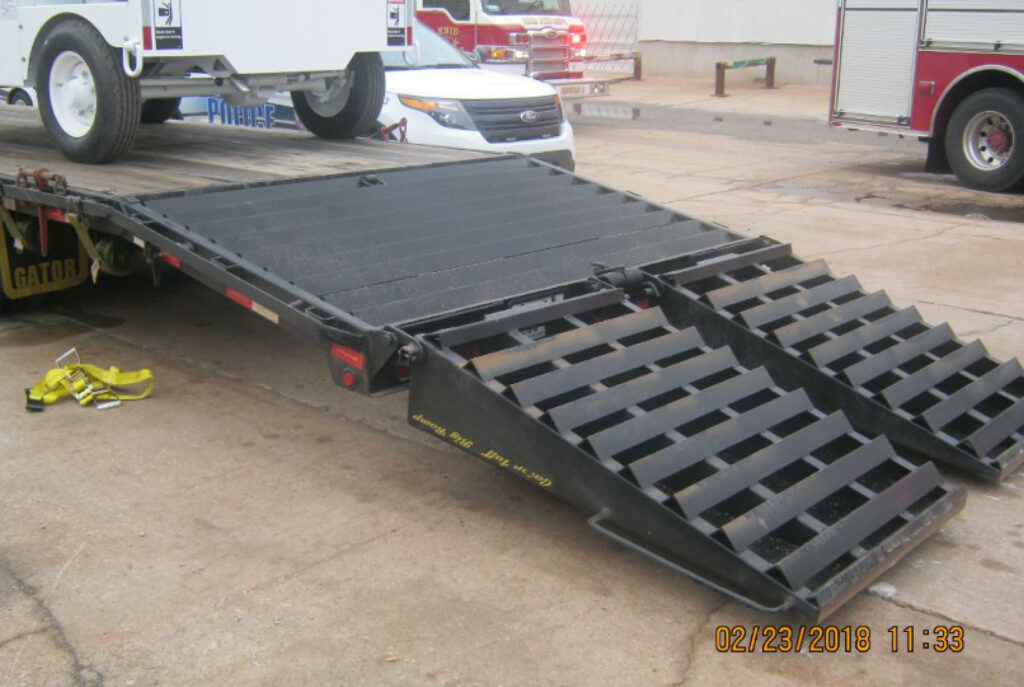
The company’s story kept shifting—and they tried to blame the weather after the fact
On the day of the incident, the driver provided a voluntary statement to police, confirming that he had revved the engine to 2200 rpm, that the street sweeper “just took off” when it hit the flat part of the trailer, and he could not react in time.
However, despite never mentioning it to police, he and the company later argued that weather conditions—not the driver—were to blame.
It is true that it was cold and misty that morning. But if the conditions were such a major factor, why not immediately mention that to the police? And why did the first driver and our independent tester have no difficulty whatsoever?
Furthermore, if the weather conditions had truly been unsafe, the machine operators (who were supposed to be familiar with the limitations of the equipment) should have refused to load the vehicles in the first place. Either way, they had clearly failed to exercise reasonable caution.
The equipment company failed to properly train employees on safety procedures
Concerningly, both drivers involved in loading the street sweepers testified that they not only had never read the manual for the brooms, but they had also never even seen it. The second driver confirmed that the equipment company never suggested he should be familiar with the manual. If he had been, he would have been familiar with several machine-specific safety warnings that, if followed, would have prevented Francisco’s death. As the operator, it was his responsibility to be familiar with the machine and operate it safely.
Furthermore, the company had a general policy forbidding anyone (including contractors like Francisco) from standing on trailers as equipment is loaded. Rather than informing Francisco of the policy and arranging an alternative loading method (for example, by providing an additional spotter), the drivers proceeded in direct violation of the policy.
Crosley Law uses rigorous focus testing to shut down the defense and fine-tune legal arguments
We knew that the insurance company would try to pin most of the blame on Francisco despite the egregiously reckless and dangerous actions of the equipment manufacturer and the broom driver. They would say a collision was unavoidable due to bad weather conditions, that Francisco put himself in a position he should have known was dangerous, and that forklift safety principles don’t apply to street sweepers (even though the driver himself admitted that they do).
The defense even had a radiologist review old, unrelated CT scans Francisco had undergone two years before the incident and claim he “likely” had undiagnosed lung cancer—a cynical, cheap stunt to question Francisco’s life expectancy and manipulate a jury into thinking his life was somehow less valuable. (For what it’s worth, our own medical expert strongly disagreed that the old scan results supported a cancer diagnosis.)
From a strictly legal perspective, we were confident we had a stronger case and better arguments. But like any case that looks like it’s heading to trial, there’s a “wild card” factor: the jury. The defense repeatedly argued the family would not receive a large verdict for their loss because there had never been a seven-figure verdict in the county where the trial was taking place. Most jury members take their role seriously, but they aren’t attorneys. They don’t always decide cases the way attorneys and legal experts would.
Because we knew the insurance company would aggressively fight this case, the Crosley Law team conducted extensive focus group and mock jury testing to hone our arguments. Hundreds of mock jurors were asked to provide detailed feedback on which arguments (from both sides) were most and least persuasive, how much blame each side deserved, how much money Francisco’s family deserved, and more.
Our years of hard work and investment in this case paid off. A little more than a month before trial was set to begin, we secured a $3 million settlement from the insurance company in mediation. The settlement holds the company and broom driver accountable for their negligent safety practices and dangerous behavior, and will support Nina, Francisco’s children, and his mother as they rebuild their lives.
RELATED POST: What is an average wrongful death settlement amount in Texas? | Crosley Law
Other key takeaways
One obvious lesson from this case is how important it is for personal injury lawyers to test their arguments in front of real, everyday people.
No matter how straightforward the case might seem to a legal expert, juries often come away with an entirely different impression. It’s important to remember that truly “easy” cases almost always settle quickly. If the case is on the verge of going to trial, it’s because both sides believe their arguments are strong enough to sway a jury. The best way to know in advance what a jury is likely to decide—including best- and worst-case scenarios—is through rigorous testing.
Another big takeaway is the importance of working with an experienced, respected, and hyper-local attorney when taking an out-of-state case. Crosley Law partnered with a firm in Oklahoma City, as well as an attorney based right in the rural Oklahoma community where the case was filed. These partners were crucial to our ultimate success.
Obviously, a local attorney can help with on-the-ground investigation and evidence-gathering. But they also provide insider knowledge of the local community and court system and can leverage their positive reputation and strong existing relationships within their legal community. Each court and judge are different, so partnering with a known and trusted attorney within that system can make a huge difference.
Injured? Call Crosley
Complex cases like this one are extremely time consuming and expensive to litigate. At six years post-incident, Nina’s claim was the oldest one left on our docket when it finally settled earlier this year.
If you have a tough personal injury or wrongful death case, you want to be sure your attorney has the resources, experience, and determination to fight for the best possible outcome—no matter what it takes. Nina’s case was referred to Crosley Law by another San Antonio law firm because they knew we were up to the challenge and wouldn’t back down.
If you or someone you love has been injured or killed in an incident that wasn’t their fault, call Crosley Law today at (210) 529-3000 for your free case evaluation.