


Proving fault in a car accident isn’t always a straightforward process, especially when there are few eyewitnesses and the drivers involved are telling different stories.
It’s true: sometimes people lie. But if the whole crash was recorded on a dash cam, your chances of a fair recovery could significantly improve.
In this blog post, we’ll take a closer look at the role of dash cam footage in crash claims, how they can help your case—or in some cases, hurt it—and practical steps you can take to protect yourself after a car wreck.
How can a dash cam help your car accident claim?
Proving liability
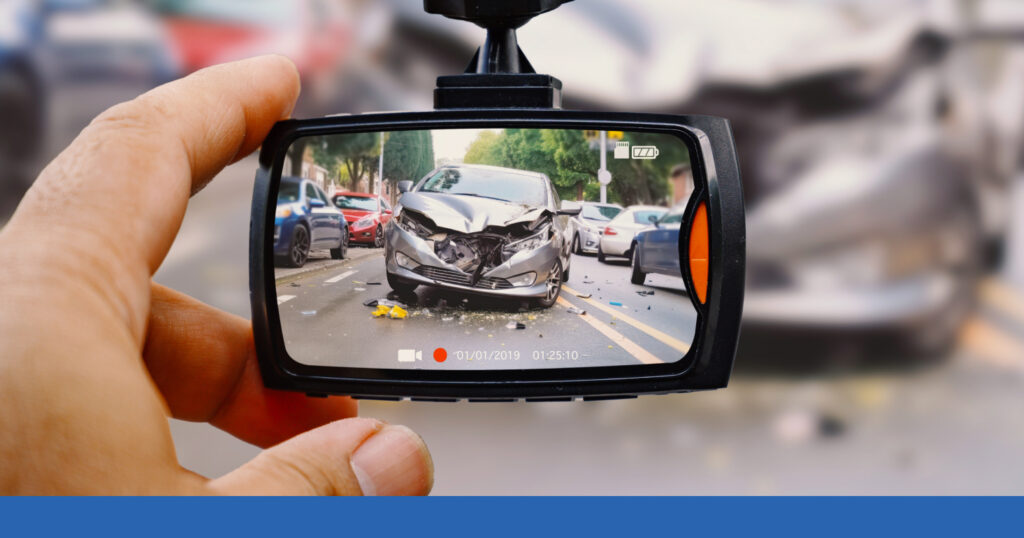
The most obvious benefit of dash cam footage is that it provides an objective witness to the events leading to the crash. This can make it much easier to determine fault for the accident.
If, for example, someone drove erratically before a crash, suddenly cut you off, or blew through a red light, your dash cam video might clearly show it. Or, if you’re a victim of a hit-and-run, the dash cam could be the crucial evidence police need to track down and identify the at-fault driver.
To be sure, an experienced car accident lawyer will incorporate additional evidence such as eyewitness accounts, electronic event data recorders (car “black boxes”), and images of the vehicle damage to build the strongest possible case. But dash cam evidence gives us another valuable tool, and it can be especially helpful in cases with few eyewitnesses or when other physical evidence is unclear or unrecoverable.
Clarifying details
Many dash cams will record the specific date, time, and location. Some even record the speed your vehicle is traveling. These are extremely relevant datapoints that can corroborate your story and aid your attorney’s investigation.
Camera footage can also provide a better estimate of the impact forces involved in the wreck. Vehicle damage alone doesn’t always provide a clear sense of how severe a crash really was. One of our previous clients suffered severe injuries despite the fact that there was almost no damage to her truck, because her trailer hitch was the point of impact. A dash cam could have helped show the extreme vehicle acceleration and deceleration consistent with a high-impact collision. (She did not have a dash cam, but fortunately we were able to use other evidence to prove her case.)
Showing events after the collision
A dash cam that’s still rolling after a crash might also capture relevant details about the at-fault driver—for example, whether they appear to be drunk or engage in hostile behavior. If your dash cam records audio, you may even get a recording of an apology, if you’re lucky.
It should be noted that most vehicles with built-in dash cams do not have audio recording capability due to privacy concerns in many jurisdictions. However, Texas is a one-party consent state, meaning you can record your conversation and use it as evidence even if the at-fault driver is unaware that they are on camera. This is one reason you might consider purchasing your own external dash cam even if your car has one already.
Potentially faster outcomes
Insurance companies are notorious for delaying, denying, and drawing out the legal process as long as possible. If any of the evidence is unclear or missing, they will try to take advantage. But if you have a dash cam recording, and that video footage is undeniable and extremely damaging to their client’s case, it could mean a quicker (and better) settlement offer for you.
That isn’t a guarantee, of course. We’ve seen insurance companies fight cases to the bitter end despite what seems to be a clear losing hand. But for obvious reasons, the stronger your case is, the better.
Potentially greater damage awards
The old cliche that a picture is worth a thousand words is very true in a lot of car accident cases.
One of the main driving forces that determine settlement values is whether the case has any “aggravating facts.” In other words: if the at-fault driver did or said anything that would really tick off a jury, that jury is likely to award more compensation.
Reckless acts caught on camera can be extremely upsetting and stick in a jury’s mind. They make the defendant immediately unlikable in a way that’s tough to recover from. The insurance company understands this well, so they may up their offer to avoid trial.
RELATED POST: What is an average settlement for pain and suffering after a car accident? | Crosley Law
How can a dash cam hurt your car accident claim?
The simplest and most obvious answer here is that, if the crash was your fault (or partly your fault), the dash cam footage can be used against you.
For example, many trucking companies require their drivers to always have operating forward- and rear-facing dash cameras. Time and time again, Crosley Law has used truck drivers’ dash camera recordings against them in legal proceedings. In one case, dash camera footage showed a truck driver picking his nose and looking to the side for several seconds before slamming into our client from behind. In another case, a tanker driver’s dash cam captured him dramatically running another truck off the road after an illegal turn.
But even if you truly weren’t responsible for the crash itself, the insurance company still might be able to take things out of context—particularly if they get their hands on several minutes’ worth of pre-crash footage.
Say that the footage showed examples of you moving back and forth in your lane, rolling through a stop sign a few minutes before the collision, or even giving an audible yawn. The insurer could use that as evidence you were drowsy or distracted at the time of the crash.
Worse, if law enforcement or the insurance company finds out that you had dash cam recordings of the crash but intentionally deleted them to protect yourself, it would be extremely damaging for your claim. You might even be charged with evidence tampering.

So, should you get a dash cam?
In general, we do recommend that safe, responsible drivers invest in a good dash cam.
While it’s true that footage can sometimes be used against you, in most cases if you were responsible for the crash, the insurance company is going to find out regardless (and lying about what happened is always a terrible idea).
But if the other driver is at fault, the footage could be the key evidence that results in a successful claim or bigger settlement. For example, say you blacked out after the crash and have no clear memory of what happened. You can see why getting everything on camera would be a big help!
What should you look for in a dash cam?
Here are a few key factors to consider when selecting a dash cam.
- Clear, sharp image. Choosing a dash cam with a higher resolution results in more detailed images. For example, a good 4K dash cam will almost always be able to read the numbers on a license plate at a greater distance than a dash cam that’s only 720p. A higher frame rate (for example, 60 frames per second versus 30) may also result in less blurry images if there’s a large speed difference between vehicles, although this depends on the camera.
- A quality SD card. Almost all aftermarket dash cams record to an SD card or microSD card, which you’ll usually need to purchase separately. In general, you want a card from a reputable manufacturer that has sufficient capacity and high endurance. Higher capacity cards (for example, 256GB vs 128GB) can store a longer amount of video before overwriting old footage. And high endurance cards can withstand more overwrites and harsher environmental conditions before failing.
- Night vision. Choose a dash cam that operates as well as possible in low lighting conditions. Not all crashes occur under bright, sunny skies.
- Automatic on. Your dash cam should turn on automatically when you start your car and begin recording immediately, so you don’t have to remember to do it manually.
- Audio recording. This is more of a double-edged sword. A dash cam that records audio can be helpful (and is legal in Texas). In addition to potentially capturing post-crash conversation, it also allows you to “take notes” in the immediate aftermath of a crash. For example, you might consider reading the other driver’s license plate number out loud (in case the dash cam wasn’t able to read it clearly). However, the audio can hurt you if you say anything that could be interpreted as an apology or admission of fault.
One additional tip: other states may have different laws about dash cams than Texas, including where they can be mounted, how large they can be, and whether you can record audio without the full consent of all parties. If you’re driving to other states, be sure to review their dash cam regulations beforehand.
Car Crash? Call Crosley
If you’ve been in a Texas car wreck, give us a call at (210) 529-3000 today. Even if you caught the entire crash on camera, that still doesn’t mean the insurance company is going to offer you a fair settlement for your injuries. Our team will help you create the strongest possible case and get the most money possible for your claim.
The content provided here is for informational purposes only and should not be construed as legal advice on any subject.